the behaviour of abstract art
does art have a soul? henri van de velde was quite sure of it: the artist just had to be able to bring out the inner being of each object. but not every artist agreed with him in this: wassily kandinsky substituted for the animistic term "soul" the word "essence" referring in a much more moderate way only to what is distinctive and particular about a work of art. however, in his first theoretical treatise “concerning the spiritual in art” ( 1910), he wrote that art must have an "inner music" which corresponded with the spiritual in man. man had a soul, and art only an essence, but something like a conversation was possible between the two.
since then abstract art has taken a variety of paths. it has followed kandinsky or rejected him and emphasized the concrete, real qualities of simple forms and colours beyond any connection with the viewer (concrete art). or else it pointed to other values, above all those concerned with the perception of mathematically definable, geometric form fields (op art, nouvelle tendence, systematic art), or the perception of movements which are usually unpredictable and can hardly be described in words (kinetic art). the question what in each of these cases constitutes the "essence" in abstract art has yet to received a definitive answer. as soon as an abstract artist departs from the answer given by one of his fellow artists, the question is posed to him anew. what is the answer of the english sculptor norman dilworth?
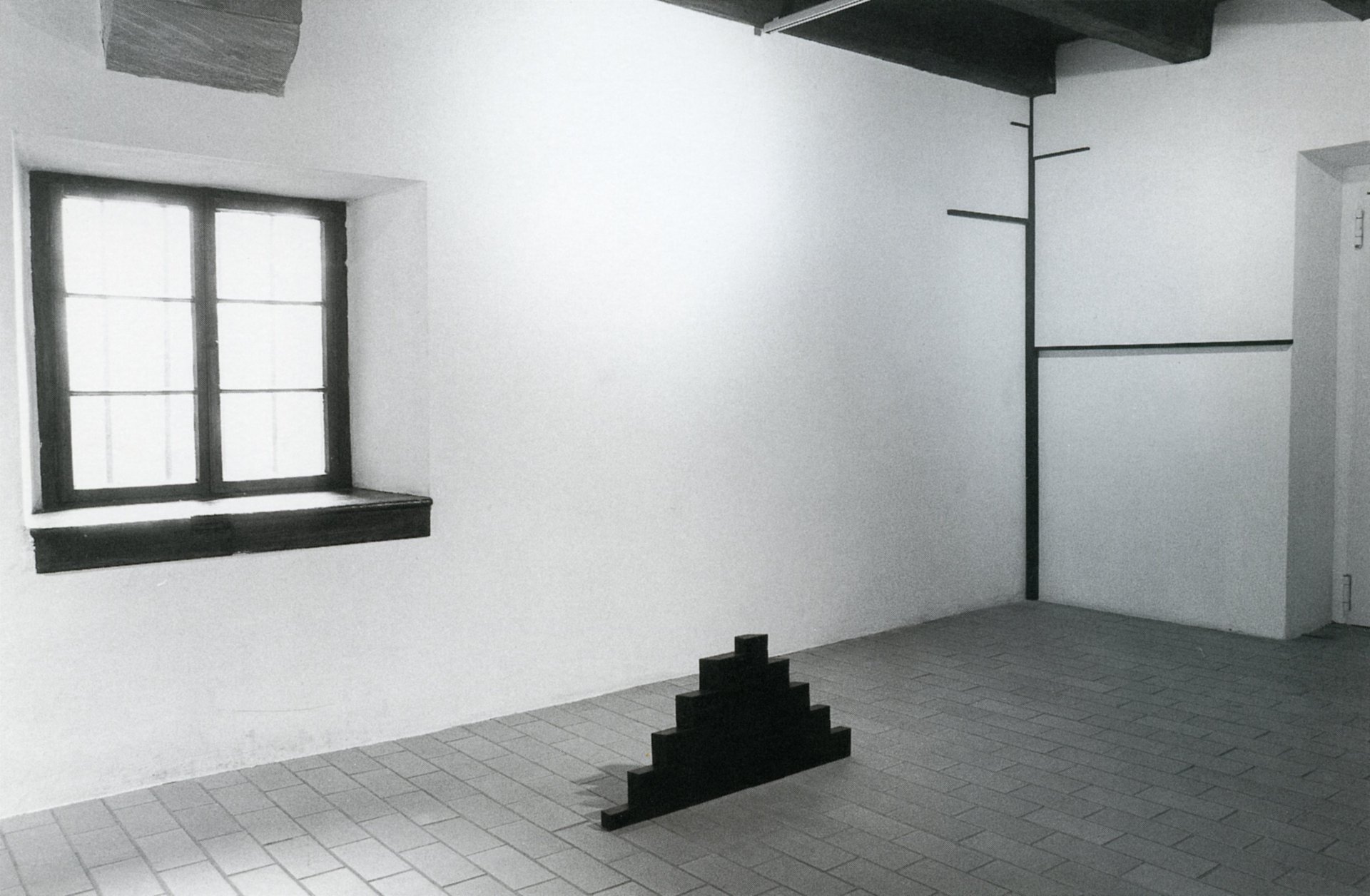
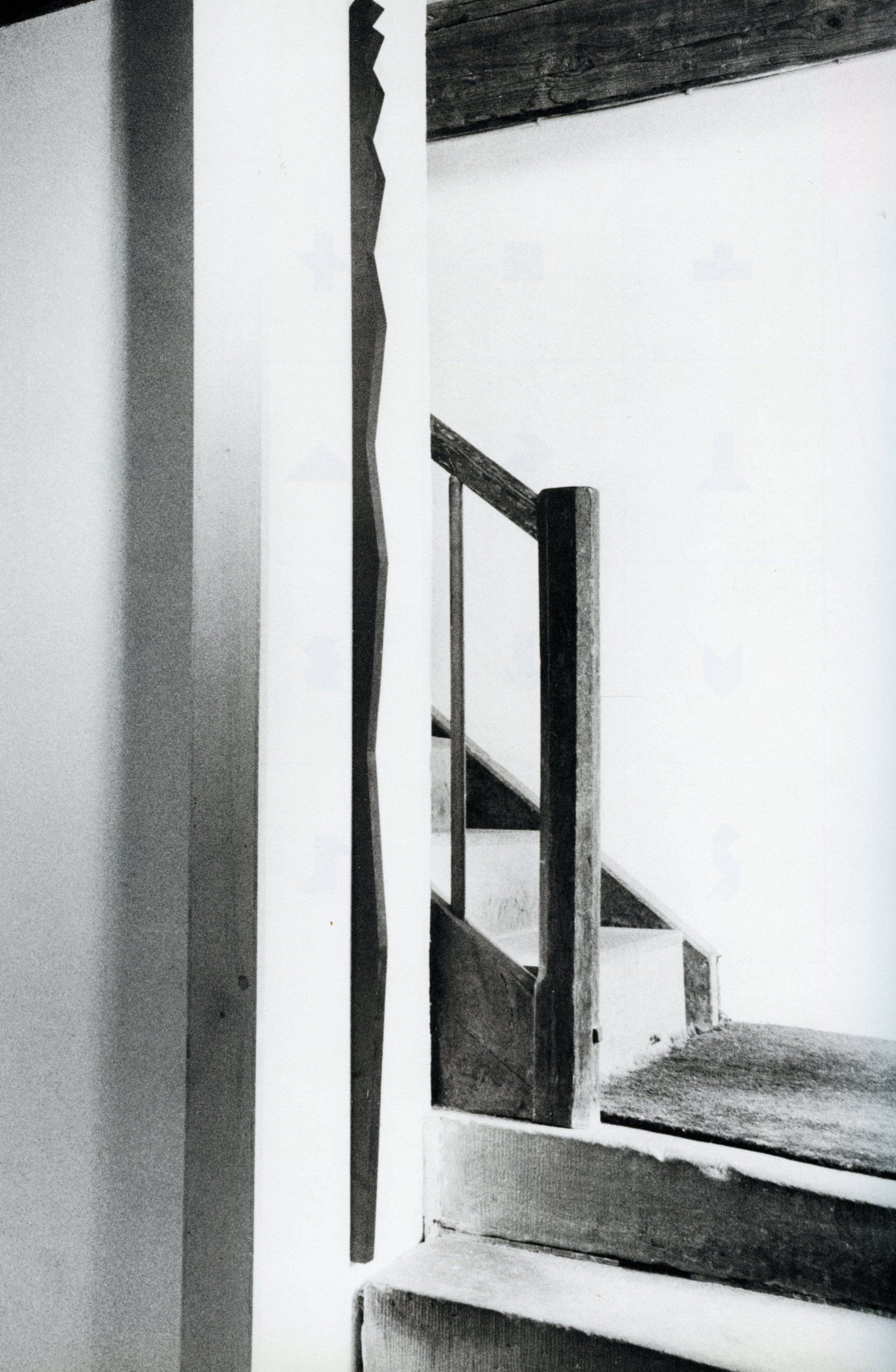
on the wall of a staircase in amsterdam his black, angular and serrated wooden rod seems to "behave" as if it were something crawling vertically up the wall. its end seems to be at the top, where a cube forms the first serration on the rod's back. the distance between the serrations increases the further they are from the cube at the top. it is a work of art in the state of progression and this geometric formation of an increase or decrease is typical of a constructivist work. or does the serrated rod in fact represent a caterpillar crawling up the wall?
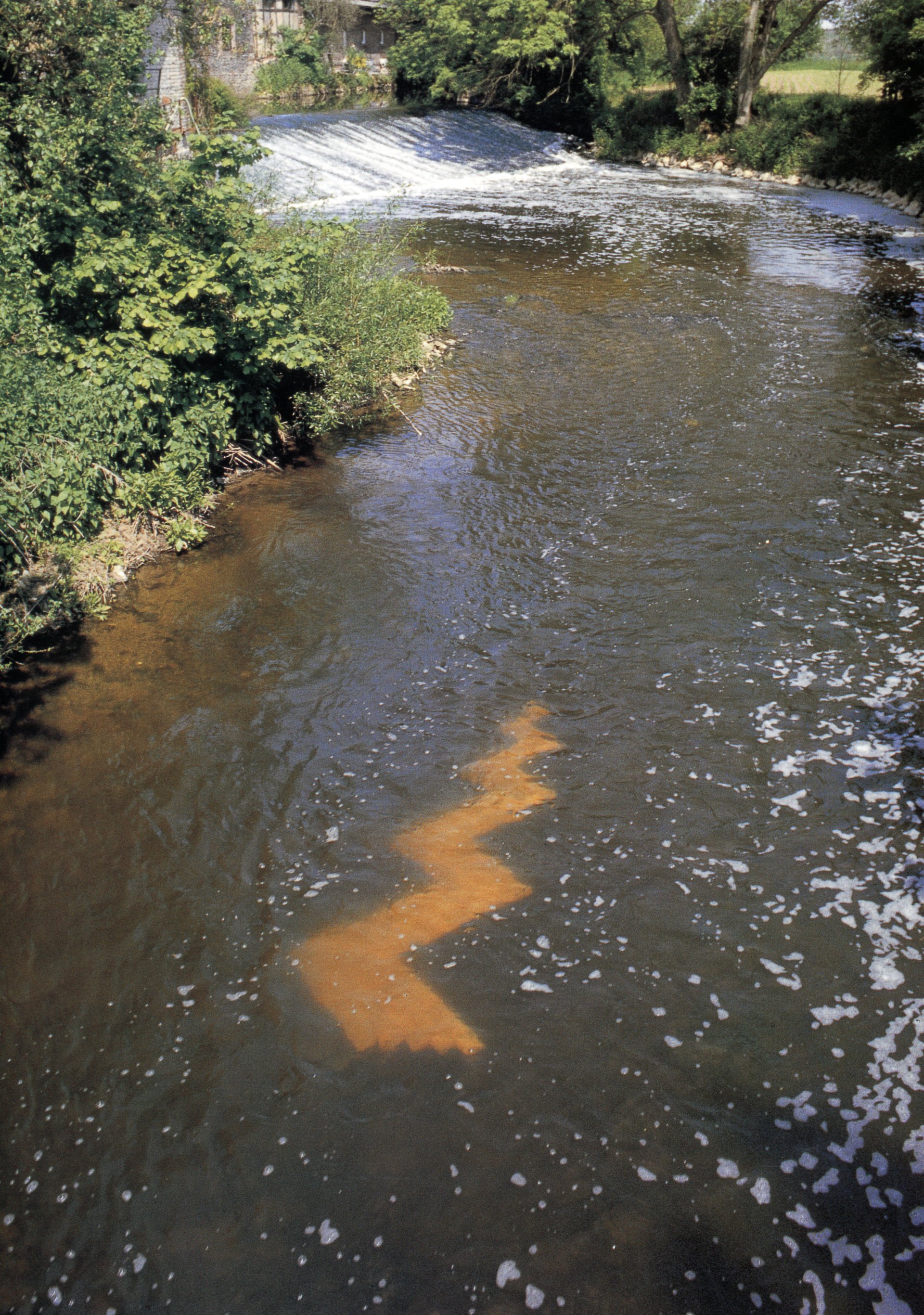
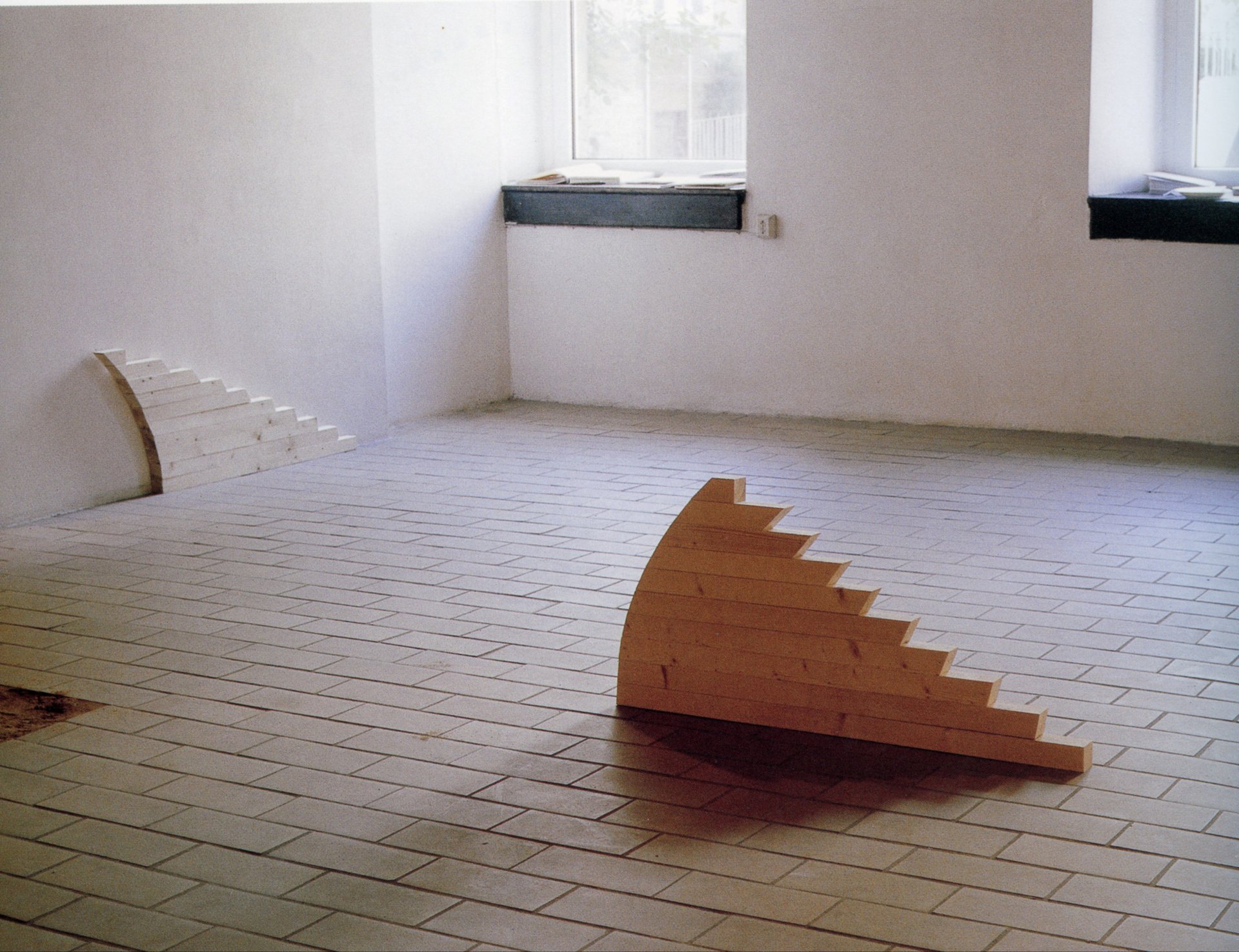
"no", says the english artist, he would never imitate nature, never represent it, only work alongside it using its principles. so a black rod can behave like a caterpillar, even if that is not intentional. other such rods by dilworth even rise up from the floor and appear to move along the ground in the movement structure of progression apparently naturally. the works suggest a behaviour. other wooden rods, tied together at the end, stand teetering on the floor, thrusting their spines upwards as if they had feet all around, not all of which were used at once, or else they seem to dance oscillating about themselves. dilworth shows me a shell , which he keeps in his studio. it has never occurred to him to represent it, but he is stimulated by its structure. "i don't want to find an image in it. it is the parallel to nature which fascinates me. i don't want to work from nature either. i'm working from the opposite direction. i'm objective in what i do," dilworth explains to me. "paradoxically, you get nearer to nature if you eliminate mimicry." he feels he is closer to artists like paul klee and hans arp, who once declared: "we allow the work to be as nature does".
why shouldn't abstract forms call upon gestural associations? but this is by no means obvious. anything reminiscent of the figurative and the narrative is anathema to orthodox constructivists. the english constructivists of the sixties and seventies, who also called themselves systems artists (anthony hill, jeffrey steeie, and others), believed in the beauty of mathematical form: they presented order as a spiritual order, movement of serial form, balanced proportions of the elements of an image to each other, progressions, field structures, developments of forms... what was the point of having associations with anthropology or animism—as if constructivist forms could not only stand in a particular relationship, but also show a behaviour of their own?
an exception to this was the late kenneth martin, a friend of norman dilworth, whose pendant and rotating kinetic sculptures could freely display their "way of life"—their swaying dances in the form of an infinitely rotating spiral. they seem inhibited in a melancholy gracefulness for they never dance out of their spiral into open space. kenneth martin, a second-generation constructivist, was already working as an unorthodox constructivist of the old school: he understood the younger generation, discussed things with them and always exhibited together with young artists. dilworth was one of these.
in english sculpture of the sixties and seventies the behaviour of a work of art was also the theme of a non-constructivist: barry flanagan. flanagan's branches, for example, press together at a point so that when placed in a circle on the floor they create a framework for a tent. his canvas pieces hang from a rod and express their own weight and the tension of the fabric. a piece of rope curls up on the floor, sacks lie and press against each other, in fact each material does what it can and does it—in the context of art—in a very satisfactory manner. the nature of the material presents itself in this "soft art" or "arte povera" as the theme and structural basis of the work. in the meantime, however, flanagan has become a sculptor of bronze figurative works: hares frolicking around in all kinds of postures, jumping, gesticulating and even boxing as if they were human. the theme of behaviour is thus actually represented and no longer just inherent in the material of the work of art. in norman dilworth's work none of these three forms of behaviour is present: his works do not move, nor does the material demonstrate its properties, nor is there any depiction of postures observed in animals or people. he says, "the work has to explain itself”, as he declared in conversation with barry barker. he went on to say: "they are not abstractions from another reality. they are real within their own terms. i am not attempting to make an illusion of something else."
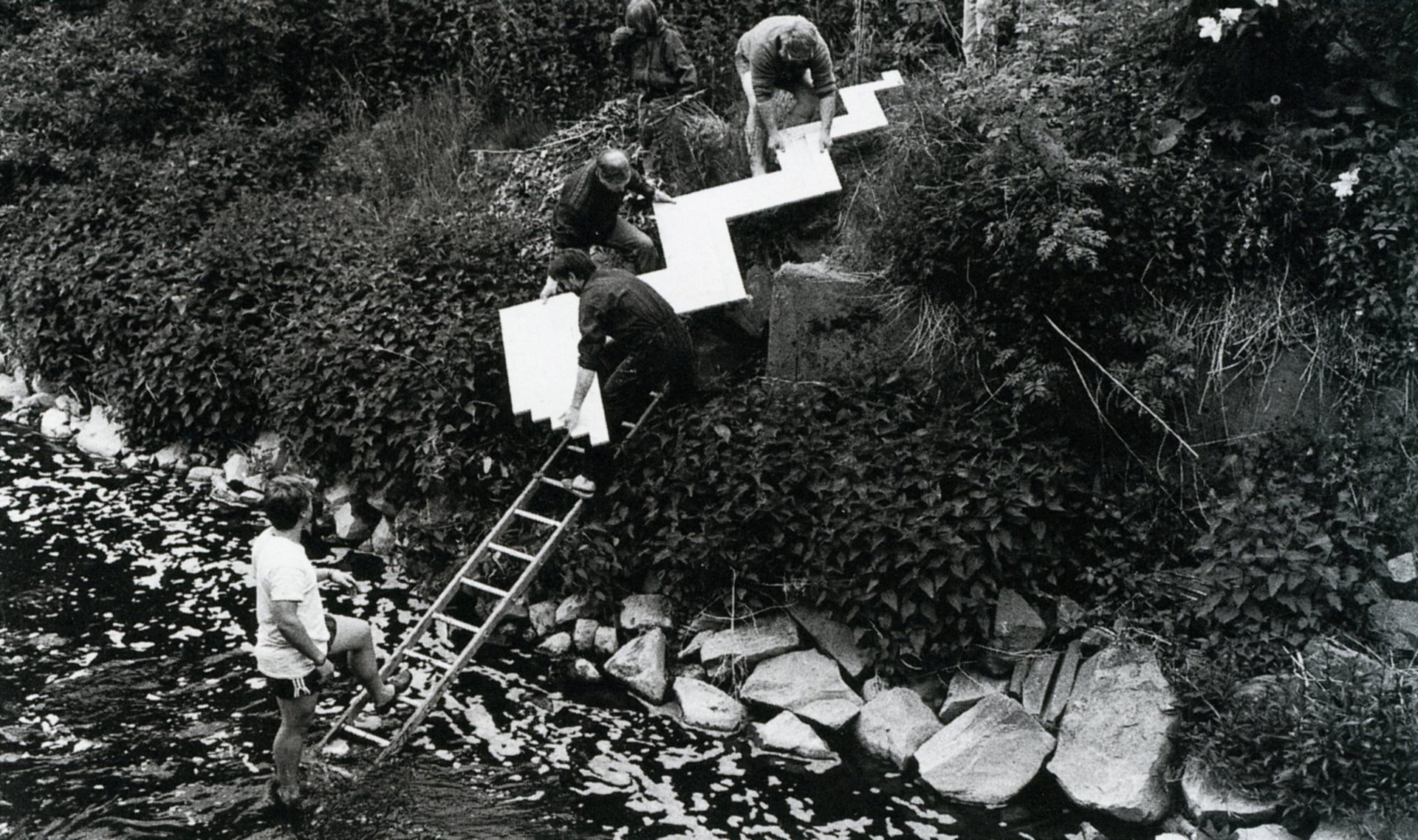
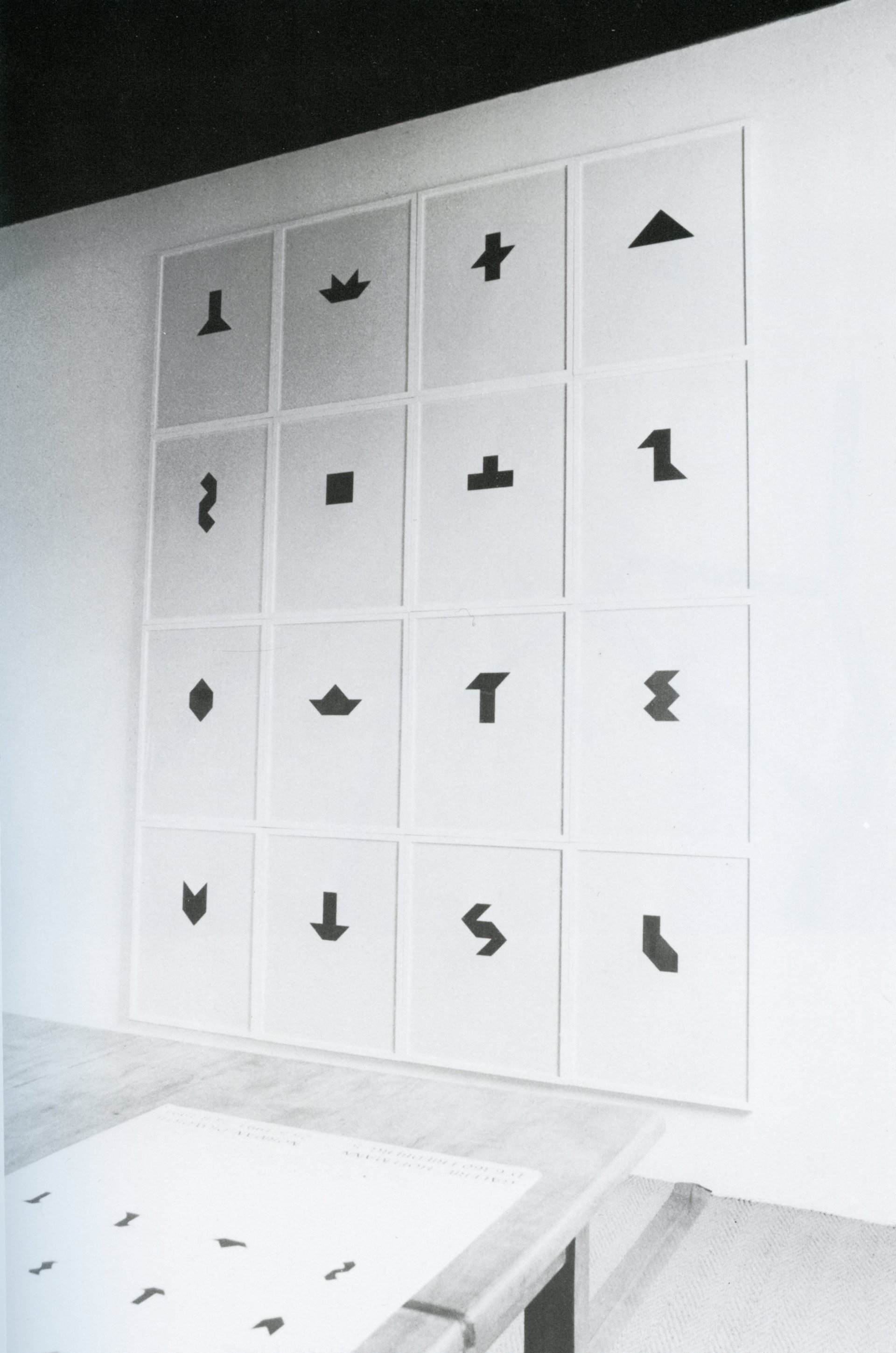
in his amsterdam studio some small wooden sculptures by norman dilworth present their behaviour as if they were abstract hands unfolding in constantly different ways. true, they consist only of black cubes and half-cubes, which the artist has put into constantly different mathematically verifiable positions, but still they seem to be gesticulating: closing, opening, pointing somewhere, squeezing together, stretching out, diverging from each other, pausing, grasping each other, reaching into the room, joining together etc. dilworth calls these "generations" and explains that he likes to work in series of this kind: "i like to make families of works which share the same origins." wooden sculptures, in themselves abstract, perform their "behaviour-activities", which remind me of calligraphic signs. and indeed dilworth now fetches a catalogue of far eastern calligraphy which has interested him for a long time. in the fifties he was a friend of the chinese artist tseng yu, who helped him to understand chinese art. calligraphy has only provided him with a distant association, but dilworth is interested in the characterization of each ink sign while at the same time retaining strict abstraction. the families of his black cube constructions on the wall could consist of the most varied characters: "i feel each one is an organic thing in itself," he says, "and i want each to arrive to an image of it's own."
he would never present calculability as a value in its own right, as many other artists of english constructivism did, even if he did go to a jesuit school which set great store by system and order, and even if as a pupil of the academic painter william coldstream (1900–1987) at the slade school in london he learned the value of making precise measurements on the canvas. but this was all the means to an end. "it must be worth more than pure measurement—i don't want the plan behind it to be that obvious—i like to leave the doors open so that you can pursue many directions." he therefore makes hardly any preliminary drawings. coldstream taught his pupils that it was only at the work itself that problems could be solved, not in the preliminary design.
lastly dilworth also does not consider it important to monitor his work process from the very beginning. he wants to allow himself to be surprised by the result and he stops working when it is successful and an "image" has been achieved, when the work stands "on its own" and demands its own space. "i feel that it has its own presence and that things are almost out of my control." in this way, therefore, more must emerge than the artist himself had expected. every work in a family has a different character, peculiarities of behaviour, which suggest a trace of mentality and not for instance that of a psychological state. the habitus of a work, its "behaviour", is not the essential of this abstract art. if this mentality could be described then perhaps on the basis of the smile it arouses in the viewer: the behaviour of things points to the illusion of their joy of life (in the suggestion of dancing, punting into the air, straddling etc.). humour and the discipline of constructivism have up to now been mutually exclusive: in norman dilworth's work they come together.
antje von graevenitz, 1991